X


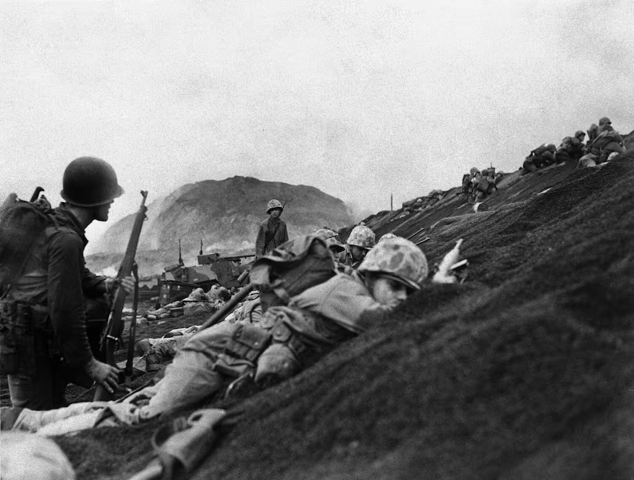
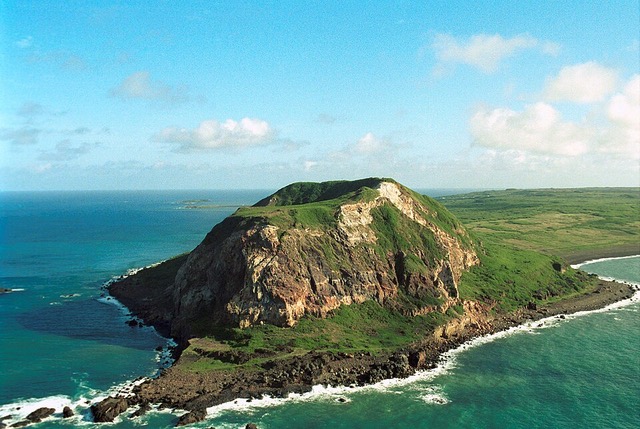
It was a special kind of hell, the charnel house of the Pacific War. On 19 February 1945, it was attacked by the largest Marine force ever to go into battle, backed by the greatest armada ever seen in the Pacific. It was a small island, seven hundred miles from Tokyo, overlooked by Mt. Suribachi, a 554-foot extinct volcano.
It was called Iwo Jima.
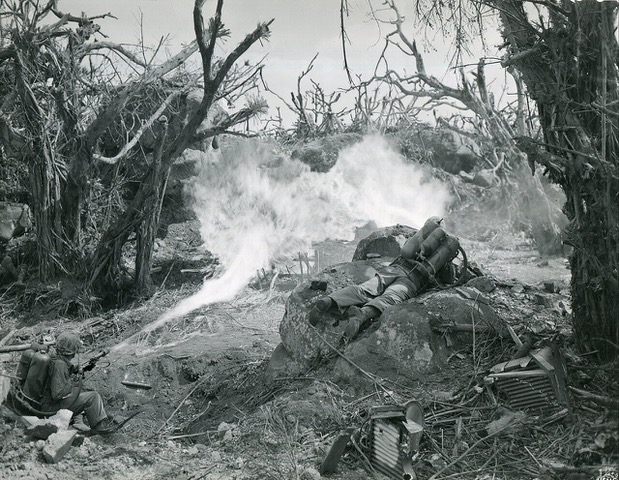
After four days of extraordinarily bloody fighting, with Marines suffering their worst wounds recorded in WWII, most of the Japanese defenders on and around Mt. Suribachi had been dealt with.
At 8 am on 23 February, Sergeant Sherman B. Watson of the 5th Marine Division set out with three privates, headed for the top of the volcano. Within an hour, they reached the cone and reported back. There was no sign of Japanese.
It was time to raise the Stars and Stripes above Iwo Jima.
A runner found Missouri native 28-year-old Lt. Harold Schrier, who had enlisted in the Marines 9 years earlier. He was told to report to Lt. Colonel Chandler Johnson.
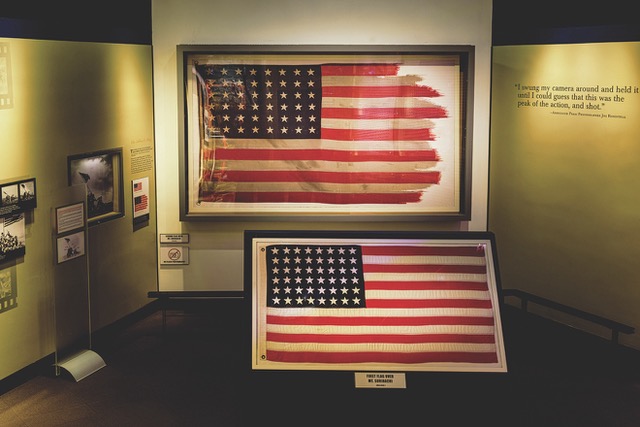
“Put this up on the hill,” said Johnson, handing Schrier a 54-by-28-inch flag that had been taken from the transport ship USS Missoula.
Schrier took forty men with him. They could be seen far and wide by other Marines as they climbed.
At 10.15 am, Schrier and his men reached the rim of the crater atop Suribachi. There appeared to be no Japanese, just an eerie quiet.
Two of the patrol found a 20-foot-long pipe. Around 10:30 a.m., Schrier, along with Platoon Sergeant Ernest Thomas, Sergeant Oliver Hansen, and Corporal Charles W. Lindberg, tied the flag to the pipe and raised it.
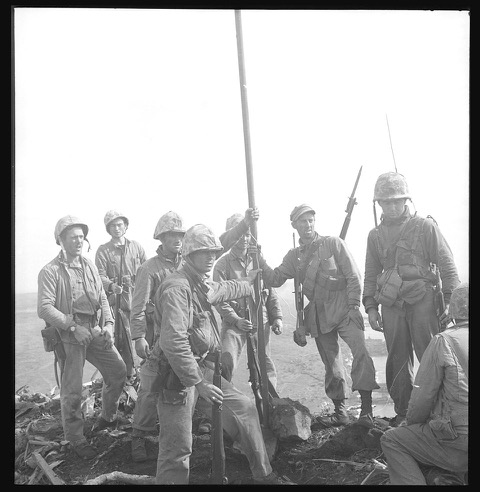
Old Glory flapped in the wind.
28-year-old Sergeant Louis Lowery, a photographer with Leatherneck magazine, snapped pictures.
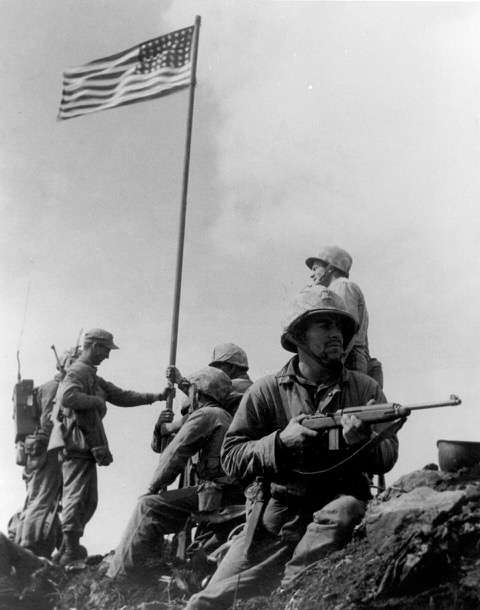
Private First Class James Robeson was not impressed.
“Hollywood Marines,” he jeered.
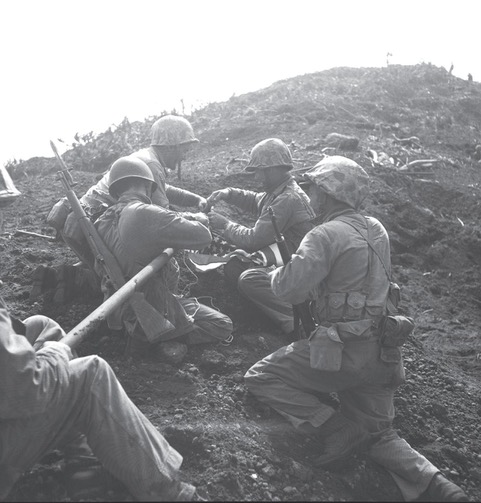
Corporal Lindberg vividly remembered what happened next:
“Then the noise came from down below, the ships started blaring horns, the troops started cheering. It was just like a big “Whoooomm” coming over that island. It gave you a funny feeling, you know... My God. We didn’t think nothing of it at first, you know, just raise the flag up and go about our work.”
“But when that noise started, oh my God ...Oh, this chill that runs through you, the thrill ... I don’t know what it was, patriotism or whatever, I don’t know. I don’t think I’ve ever had that kind of a feeling before, or after. It didn’t last long, though. All of a sudden, some shots were fired off to our side there. Someone had come out of a cave, so we had to move against ‘em.”
Two Japanese had leapt from a cave. One threw a grenade and ran toward the flag, sword drawn. He was shot three times and fell on his sword, dead.
The other Japanese threw a grenade toward Lowery, who jumped over the volcano’s rim and slid several yards down Suribachi, smashing his camera. Thankfully, the film was not damaged.
Americans on the killing fields below stared in pride, many with eyes full of tears.
“There goes the flag!” men cried.
Traumatized Marines, exhausted beyond words, thumped each other and rejoiced. Out at sea, aboard the invasion armada, a glorious cacophony continued: whistles shrilling, horns blaring, and bells ringing.
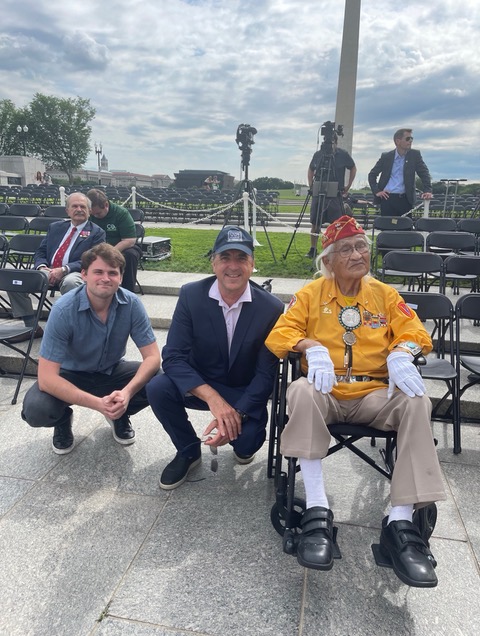
5th Marine Thomas Begay would never forget the moment. “Boy, I was so proud,” he told me in 2021. “We yelled out when they raised the flag.”
More than 500 men from Begay’s regiment died on Iwo Jima. Today, age 100, he is one of just two surviving Navajo code-talkers from WWII.
On the beach below Suribachi, by incredible coincidence, was none other than Secretary of the Navy James Forrestal. He looked up and saw the first flag flying.
“This means a Marine Corps for the next 500 years,” said Forrestal.
Meanwhile, Lt. Colonel Johnson realized he had a problem.
“Some son of a bitch is going to want that flag,” he said, “but he’s not going to get it. That’s our flag.”
The son of a bitch was Forrestal, who wanted the flag as a souvenir.
“To hell with that,” Johnson declared. “Better find another one and get it up there, and bring back ours.”
Johnson added: “And make it a bigger one.”
A 96-by-56-inch flag was found. Five men climbed up Mt. Suribachi with it. As they began to replace the first flag with the larger one, three photographers, including AP’s Joe Rosenthal, arrived on the scene.
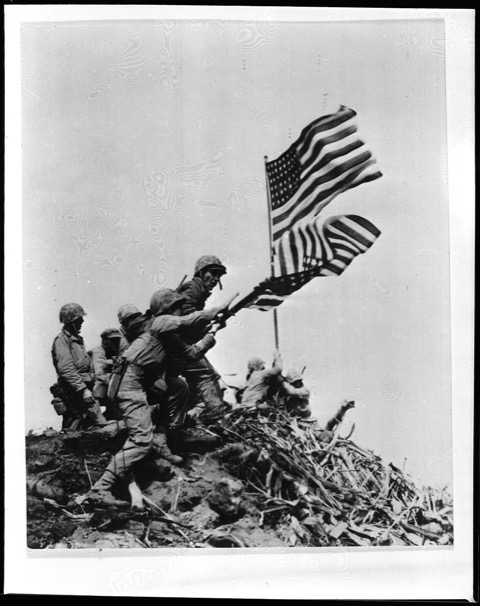
33-year-old Rosenthal set down his camera so he could pile rocks to stand on for a better shot. At that moment, Marines began raising the flag.
Rosenthal grabbed his camera and snapped a photograph, not even looking through the viewfinder.
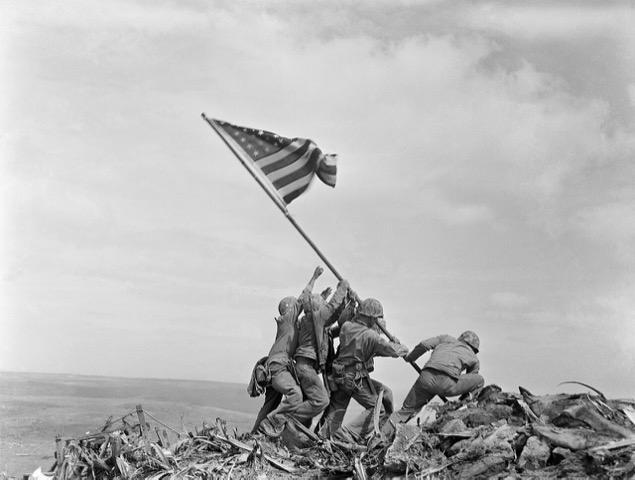
“Out of the corner of my eye,” Rosenthal remembered, “I had seen the men start the flag up. I swung my camera and shot the scene. That is how the picture was taken, and when you take a picture like that, you don't come away saying you got a great shot. You don't know.”
Rosenthal got back down the mountain in one piece and sent his film to Guam for development and printing.
“Here's one for all time!” declared photo editor John Bodkin, who transmitted the image to AP headquarters in New York City - just seventeen hours and thirty minutes after Rosenthal had snapped it.
Hundreds of newspapers picked it up from the wire, most placing it on the front page. The rest is history – eight decades later, the image remains the iconic photograph of the entire Pacific War.
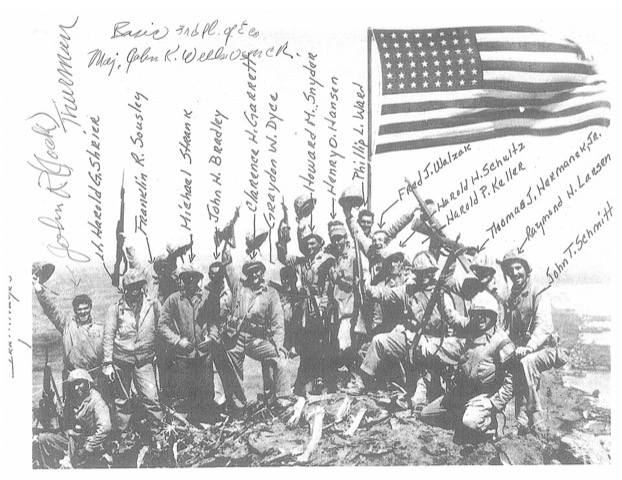
There has been considerable controversy over the decades about who exactly appeared in Rosenthal’s shot, reproduced endlessly, and the inspiration for the book and film Flags of Our Fathers. Historians have spent inordinate time correcting the record. What’s never been disputed is that three of the second-flag raisers did not survive Iwo Jima, joining 6800 dead Americans from the battle, which ended on 26 March. The total US casualties of 26,000 exceeded those of the Japanese. Astonishingly, all but a few hundred of the 22,000 defenders, refusing to surrender, died on the first Japanese territory to be fought over in WWII.
What of Lowery’s photographs? Because the Marine Corps agreed with AP not to release them until 1947, the story of the first flag raising is now “a forgotten footnote in the public mind”. Like the men who raised the first, history-making flag, the images are virtually unknown.
Two of those first flag-raisers were soon killed: 25-year-old Sgt. Henry O. Hansen on 1 March, and 20-year-old Sgt. Ernest “Boots” Thomas two days later. Hansen left behind a sister and three brothers. Thomas had tried to enlist twice but was rejected because he was color blind. He tried again, memorizing patterns given to him by a man in a testing center, and succeeded.
And what of the flags?
Both are preserved and rotated for display at the National Museum of the Marine Corps near Marine Corps Base Quantico. 81 years after the Battle of Iwo Jima, they remind us of Admiral Chester Nimitz’s immortal words describing the men who raised them: “Uncommon valor was a common virtue.”