X


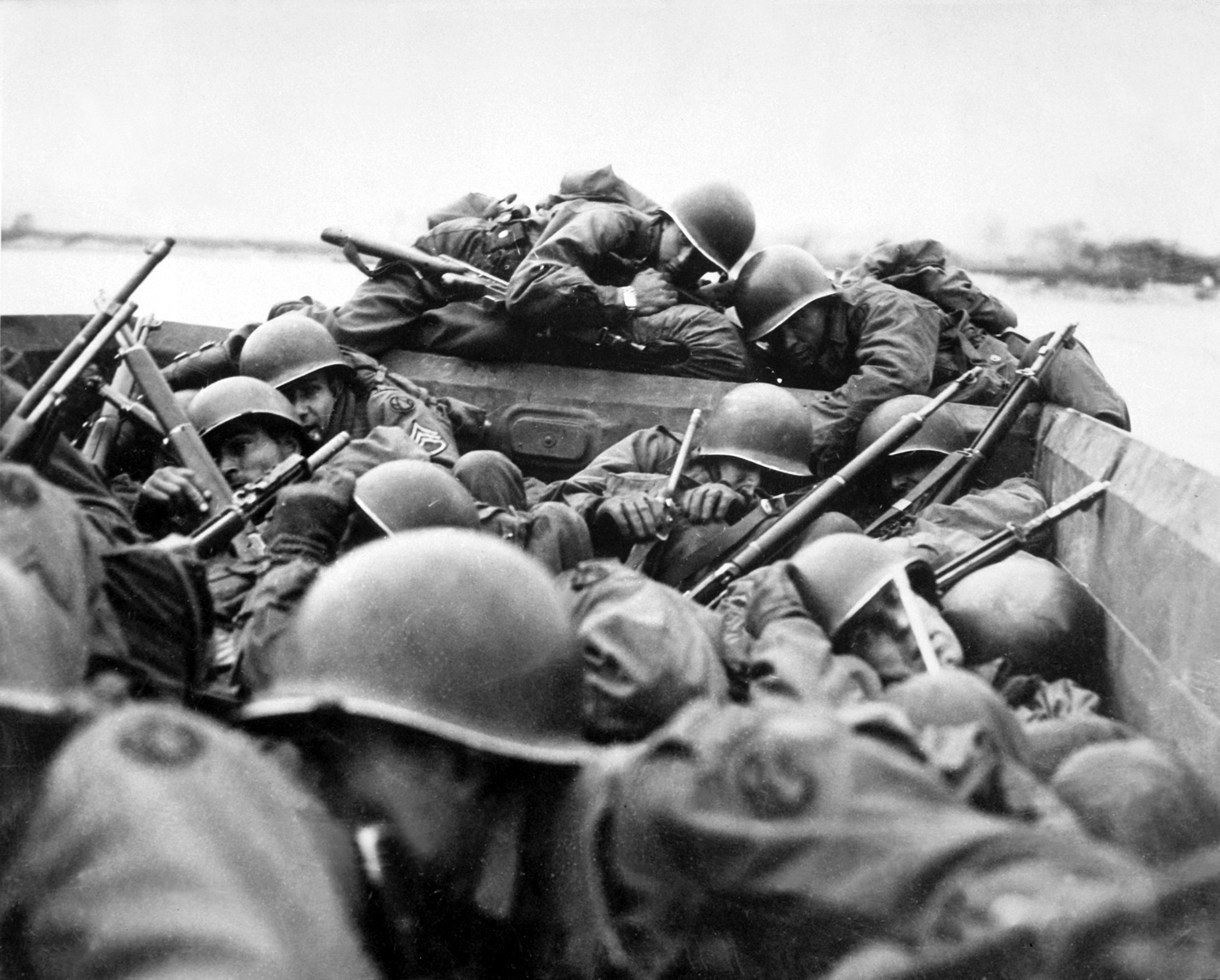
By March 1945, the Allies on the Western Front confronted one last, great obstacle: the Rhine, the “inner door” to the Third Reich, a moat, a bulwark, spanning 766 miles, flowing northward, with a fatally swift current. Getting across was a formidable challenge. According to a top-secret report sent from Winston’s Churchill’s office, doing so would be as difficult as the D Day invasion.
The fastest and easiest way across was obviously via bridges. But most had been destroyed by Allied bombing or the retreating Germans. And Hitler had ordered the last few still standing to be blown sky high when the Allies were just about to cross. He also designated key towns and cities along the Rhine as fortresses, to be defended to the last man.
On 2 March 1945, a group of German-speaking American soldiers disguised in German uniforms managed to cross the Rhine at Oberkassel, near Düsseldorf. All went well until they were confronted by a German soldier who quickly realized they were Americans. The soldier raised the alarm, and the bridge was quickly blown.
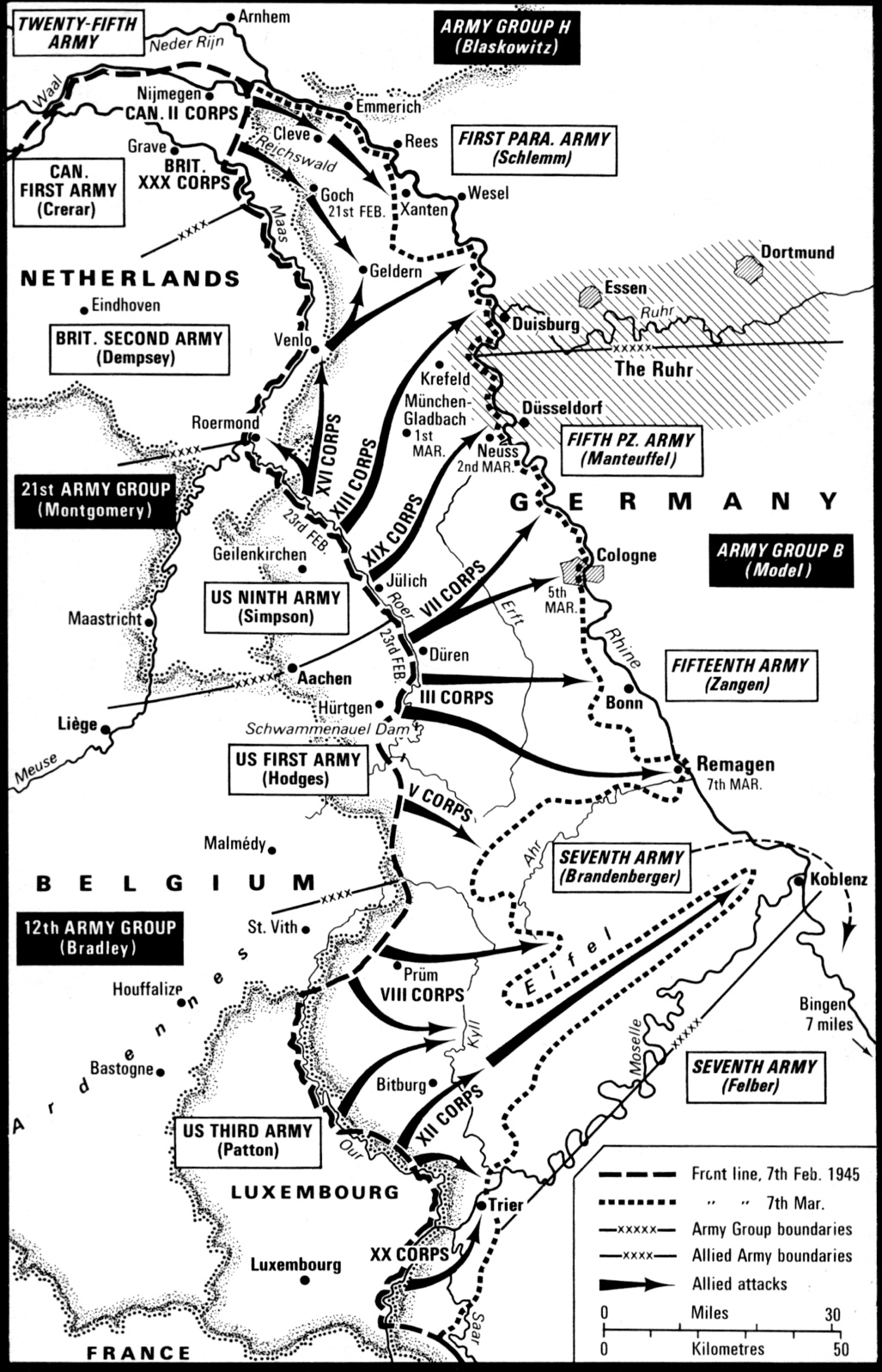
The following day, the US 2nd Armored Division neared another bridge, named after Adolf Hitler, also near Dusseldorf. The plan was for an infantry company to cross and overpower the defenders on the other side while engineers dealt with demolition charges on the bridge.
Tankers made it to the Rhine and then looked out over the Adolf Hitler Bridge, stretching 1,640 feet across. There seemed to be a real possibility of taking the bridge before it was blown, but it was not to be. As American troops approached, there was a massive explosion, and the bridge named after the Führer fell into the river.
Others still stood. Men of the Ninth Army’s 83rd Division discovered another bridge, yet again near Düsseldorf. A task force was quickly formed, with tanks camouflaged to resemble German panzers, and set off just after nightfall. As dawn broke on 4 March, the task force arrived in sight of the bridge. But as the first U.S. tank rolled onto the bridge, there was another massive explosion.
Around midday on March 7, the spearhead of the 9th Armored Division arrived at Remagen, fifty miles south of Dusseldorf. Scouts were surprised to see the Lundendorff Bridge still standing. Men from the 27th Armored Infantry Battalion were ordered to capture it intact.
Battalion commander Major Murray Deevers joined the men of A Company as they prepared to cross quickly. They had been told the bridge would be blown at 4 pm – in less than twenty minutes.
“Do you think you can get your company across that bridge?” Deevers asked Lt. Karl Timmermann, commanding A Company.
“Well, we can try it, sir,” replied Timmermann.
“Go ahead.”
“What if the bridge blows up in my face?’ asked Timmermann.
Deevers did not reply.

Timmermann took a good look at the bridge. He felt as if he’d just been handed a death sentence.
A cold rain was falling.
Just as Timmermann and his men moved out, there was a massive explosion. The bridge seemed to lift up. Smoke and debris filled the air.
Men sighed with relief. The suicide mission was over. But then, to their astonishment, they saw that the bridge was still standing. The Germans had failed to use enough explosives.
Just ten minutes before the deadline, Sergeant Alexander Drabik, a butcher from Ohio, became the first American soldier across the Rhine, closely followed by Lt. Timmermann. It was an astonishing break for the Americans, and they were quick to exploit it, throwing division after division, under increasing shellfire, across the creaking planks of the “Ludy”, as the bridge was soon known.
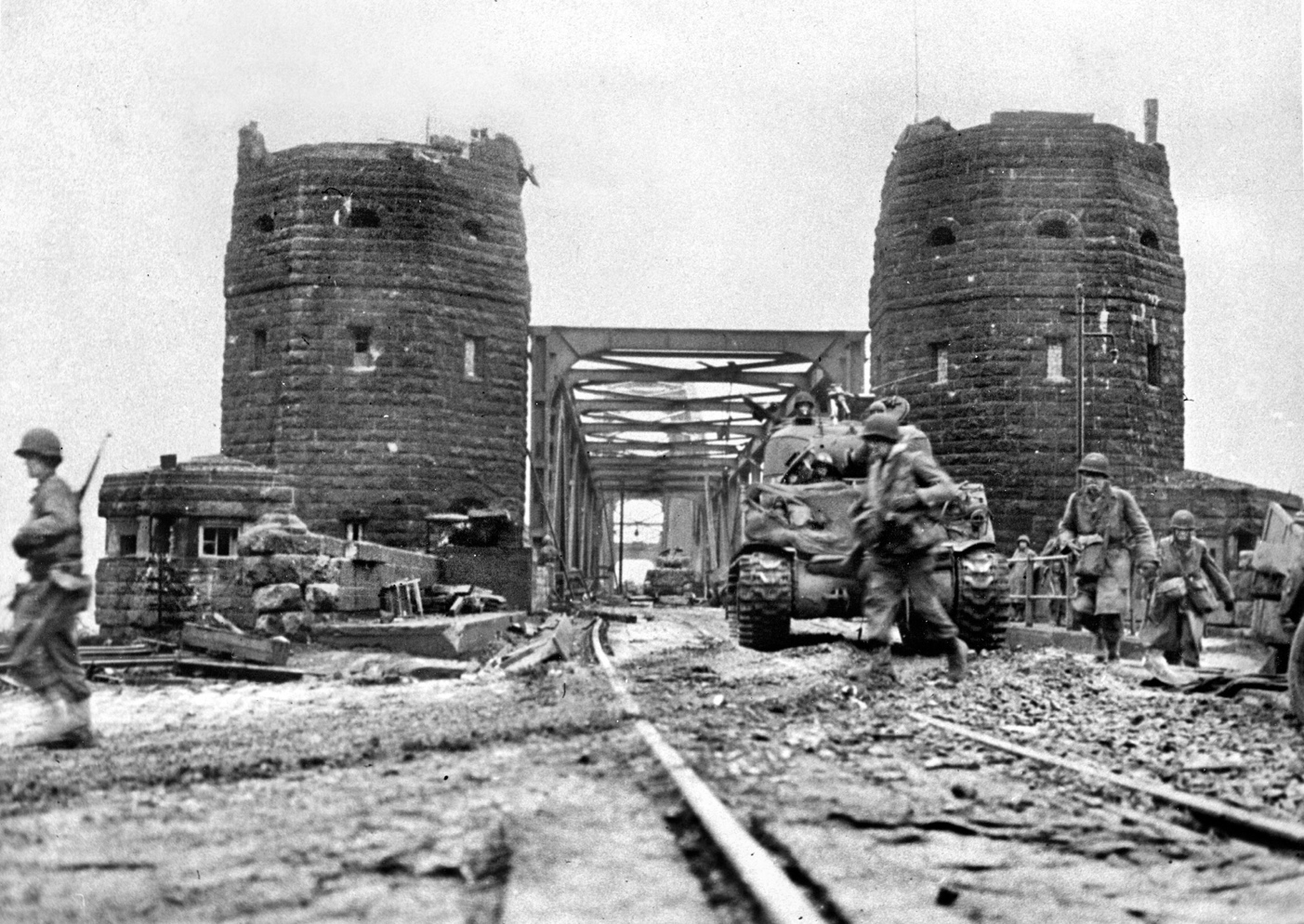
Within a week, some 25,000 Allied troops had crossed and the Remagen bridgehead jutted eight miles into enemy territory and stretched twenty-five miles wide. Under constant attack - by artillery, Stuka dive-bombers, SS frogmen carrying explosives, the world’s first jet bombers and V-2 rockets - the “Ludy’ finally collapsed on 17 March, killing 33 engineers working to repair it.
Far to the north, meanwhile, Field Marshal Sir Bernard Montgomery was putting the finishing touches to Operation Plunder, his planned Rhine crossing, confident his huge force of over a million men would meet little opposition.
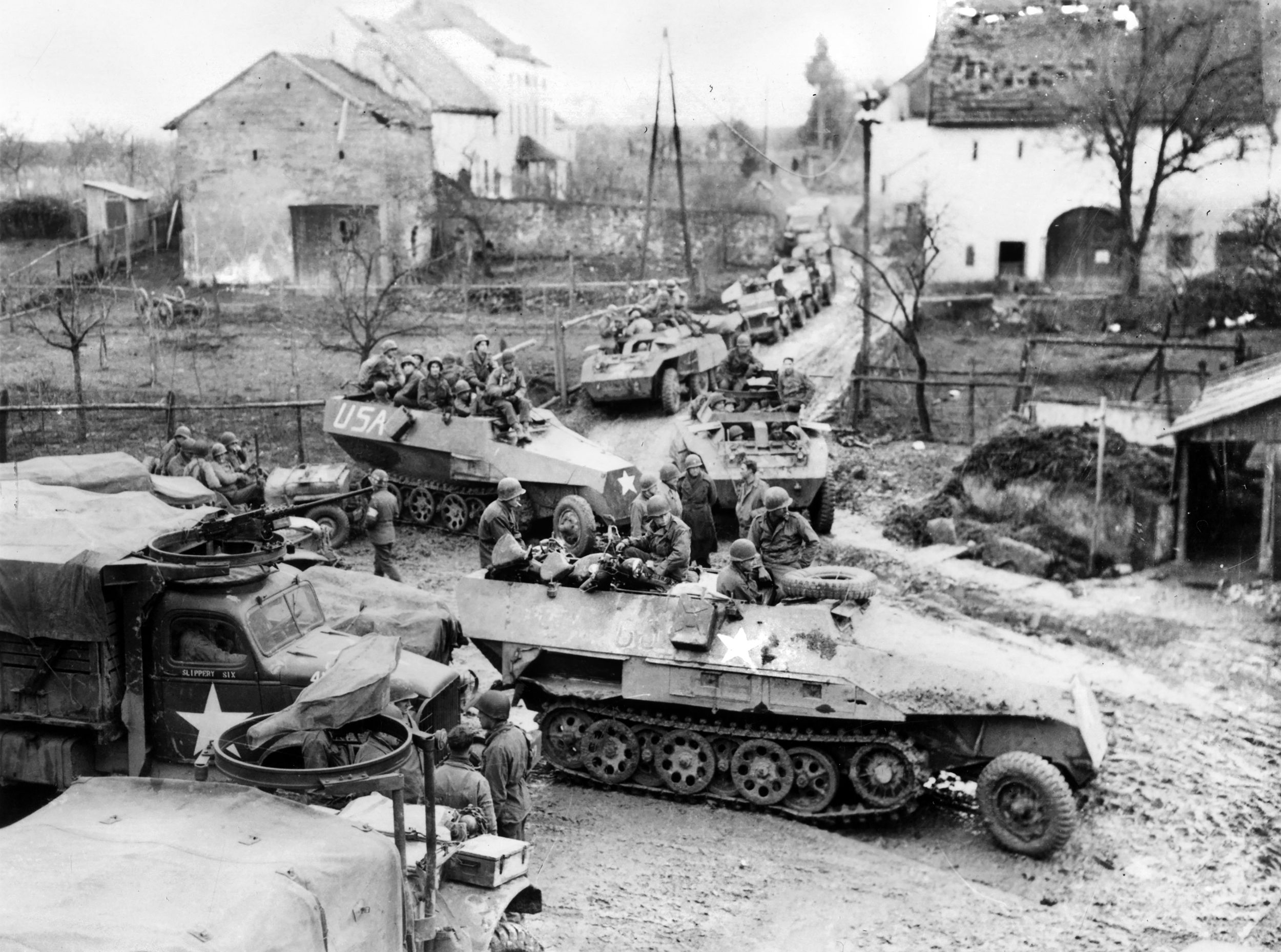
To the south, 3rd Army commander George Patton, determined to upstage “that little fart”, as he called Montgomery, pushed his forces relentlessly. On 22 March 1945 at 10pm, just hours before Montgomery’s Operation Plunder began, Patton sent men across the Rhine at Nierstein, without the support of aircraft, artillery, or airborne troops.
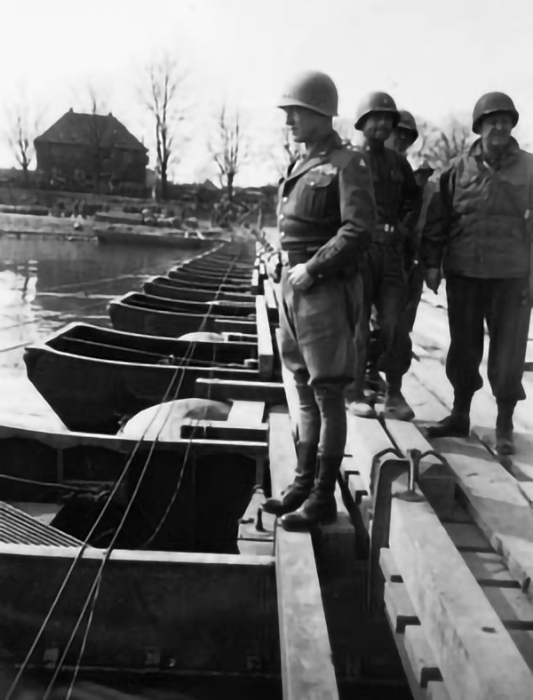
By late afternoon on 23 March, engineers had completed a 40-ton treadway bridge. Patton’s forces were six miles beyond the Rhine and had captured 19,000 German soldiers.
An elated Patton called Bradley.
“Brad, don’t tell anyone but I’m across.”
“Well, I’ll be damned—you mean across the Rhine?”
“Sure am, I sneaked a division over last night.”
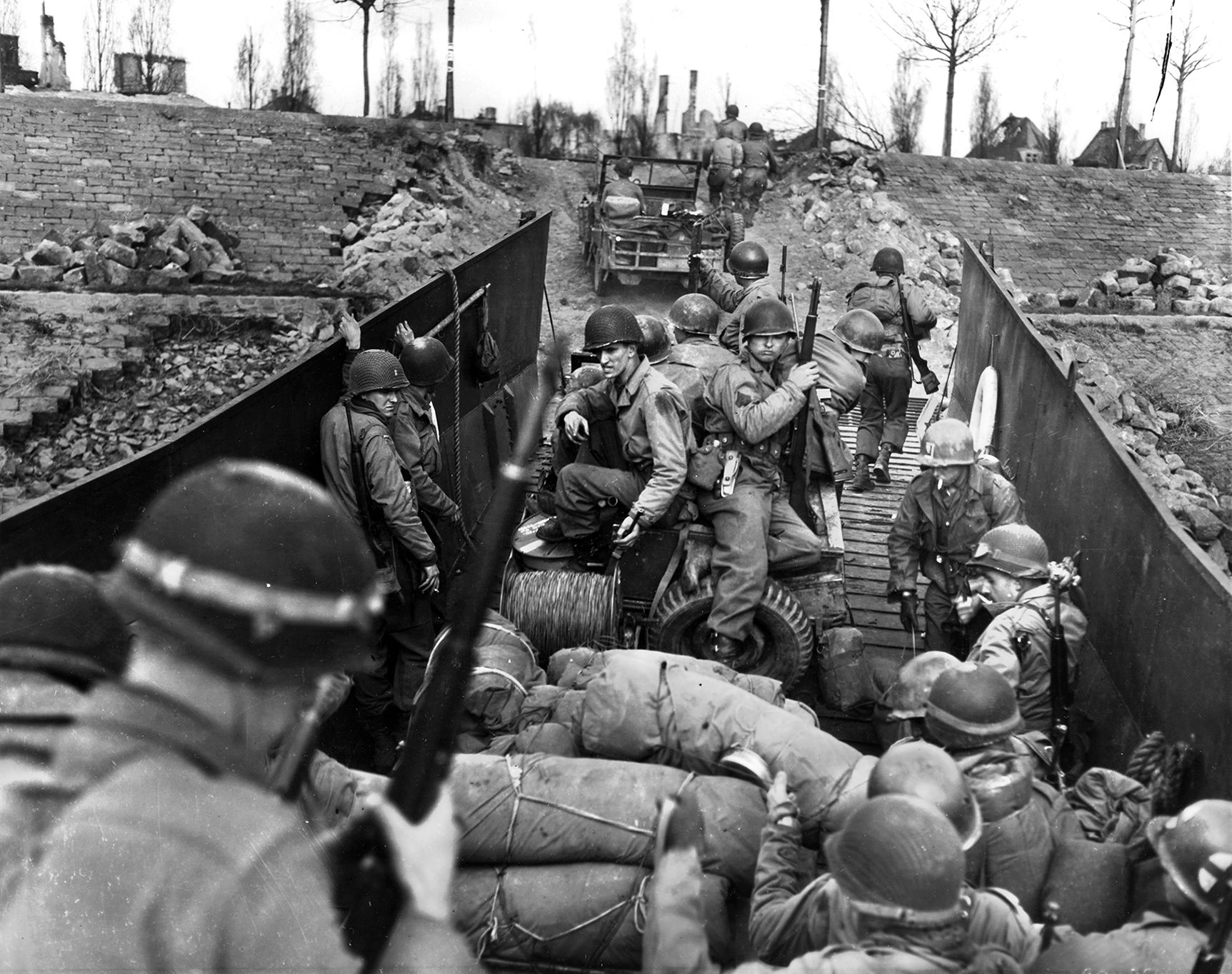
Patton himself crossed the Rhine that day, stopping half way on the treadway bridge. He then urinated into the river.
“I’ve waited a long time to do that,” said Patton. “I didn’t even piss this morning when I got up so I would have a really full load. Yes, sir, the pause that refreshes.”
Patton ambled to the eastern bank and then dropped to his knees, scooped up soil and stood up.
“Thus William the Conqueror.”
Bradley, who disliked Montgomery as much, if not more, than Patton, was quick to announce Patton’s success. Just as he had in Sicily in August 1943, when he reached Messina first, Patton had pipped Montgomery to the post.
By the end of March 1945, the Allies were pressing toward Berlin, having crossed the last great obstacle of WWII in Europe, the Rhine. Now, as Eisenhower put it gleefully, “the final defeat of the enemy was just around the corner.”


